
The Bee in Our Logo - World Bee Day 2026
The Quiet Warnings
There are moments in history when warning signs appear quietly at first.
A missing birdsong at dawn. An empty windshield where insects once gathered in summer. Orchards flowering without the familiar hum of pollinators moving from blossom to blossom. Small absences that, on their own, seem insignificant. Easy to dismiss. Easy to explain away as coincidence or seasonal variation.
But over time, the pattern becomes harder to ignore.
Across the world, scientists are documenting significant declines in insect populations, including pollinators that sit at the very centre of life on Earth. What once seemed anecdotal is increasingly supported by evidence emerging from ecology, agriculture and environmental science. The systems that sustain life are under pressure, and insects may be the first to tell us — the canary in the coal mine.
Why the Bee Matters
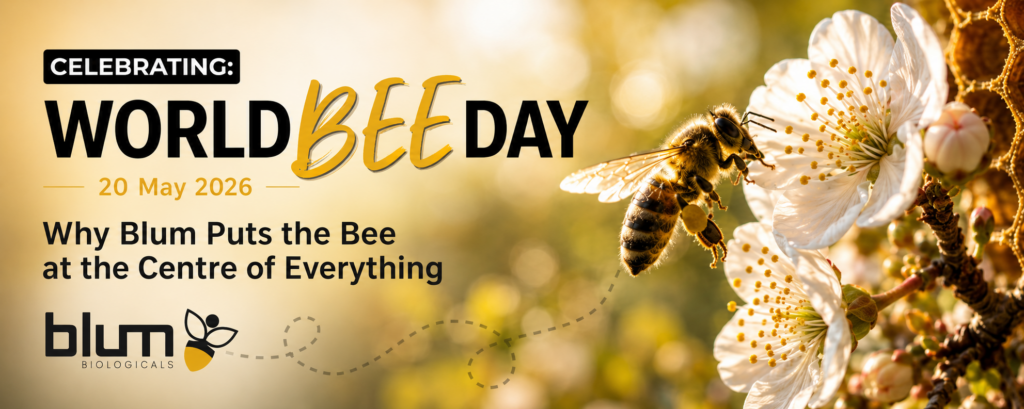
At Blum Biologicals, World Bee Day carries a meaning that goes far beyond symbolism. The bee is not simply an insect we admire. It is our logo, our emblem and a reflection of the biological philosophy that drives our company. Bees are far more than producers of honey. They are infrastructure for life.
Nearly 75% of the world’s food crops depend, at least in part, on pollinators. One out of every three bites of food we eat exists because pollinators perform their invisible work first. Fruits, nuts, vegetables, oilseeds and countless natural ecosystems depend upon billions of tiny biological interactions occurring every day, mostly unnoticed by humanity.
Without pollinators, ecosystems weaken. Agricultural productivity declines. Biodiversity erodes. Food systems become increasingly fragile. The stability of civilisation itself rests upon these delicate biological networks.
Rachel Carson’s Prophecy
More than sixty years ago, marine biologist Rachel Carson recognised that modern agriculture was beginning to interfere with those networks in ways we did not yet fully understand.
In 1962, her landmark book Silent Spring warned that chemicals designed to kill pests would not remain confined to their intended targets. They would move through ecosystems, accumulating in soil, water, plants, insects, birds and animals.
Her warning was profound because it challenged the assumption that technological progress existed separately from biology. Carson understood that life operates as an interconnected system, and that disturbing one part of that system can create consequences far beyond what we initially see.
She imagined a future spring without birdsong. Today, her warning feels increasingly prophetic.
Insect Armageddon
Scientists around the world are now studying what some researchers have termed “An Insect Armageddon” — the accelerating decline of insect populations across many regions of the planet.
Long-term monitoring studies in parts of Europe have documented dramatic reductions in flying insect biomass over recent decades. Pollinators including bees and butterflies face mounting pressures from habitat loss, climate instability, industrial agricultural practices and chemical exposure. The implications extend far beyond insects themselves.
Bees and other pollinators are foundational to the biological systems that sustain agriculture. When pollinators decline, the consequences ripple outward through ecosystems, food production and ultimately human health. Yet the visible decline of insects may represent only part of the story if you look at the population decline of frogs, the feminisation of alligators in the Florida Everglades and the mutation of the human epigenome.
The Invisible Layer of Biology
At Blum Biologicals, we are deeply interested in an emerging scientific frontier that raises even more profound questions about humanity’s relationship with chemistry and biology: epigenetics.
For decades, toxicology has largely focused on direct exposure and immediate effects. But epigenetics suggests that environmental exposures may influence biology in more subtle and enduring ways. Rather than changing DNA itself, environmental stressors may alter how genes are expressed through the epigenome, biology’s regulatory system.
Research from scientists such as Professor Michael Skinner has demonstrated that certain chemical exposures in laboratory models can produce biological effects that persist across multiple generations through epigenetic inheritance.
In other words, the consequences of environmental chemistry may not necessarily end with the individual exposed. They may ripple forward biologically through time. If this science proves even partially correct at scale, then it fundamentally changes how we must think about agriculture, environmental stewardship and chemical design.
Agriculture ceases to be merely a system of production. It becomes a system participating in biological inheritance itself.
Africa’s Opportunity
Africa, perhaps more than any other continent, stands at the centre of both this challenge and this opportunity.
The continent possesses extraordinary biological wealth, including more than 2,000 known bee species, many found nowhere else on Earth. From the Cape Floristic Region to the forests of Central Africa, pollinators quietly sustain both natural ecosystems and agricultural productivity across vast landscapes.
At the same time, Africa faces immense pressure to expand food production for a rapidly growing population. The question is not whether African agriculture should intensify.
It must. The real question is whether Africa can build the next generation of agriculture without repeating some of the ecological mistakes made elsewhere in the world. We believe it can.
In fact, we believe Africa has an opportunity to lead because the future of agriculture belongs not to those who apply the most chemistry, but to those who best understand biology.
Why Blum Exists
This is one of the central reasons Blum exists.
We believe agriculture is entering a new era, described as the “Second Green Revolution”, one that must move beyond the narrow idea that productivity alone defines success. Feeding a growing global population remains essential, but the methods we use to achieve that goal matter profoundly.
The future of agriculture cannot rely solely on forcing biological systems harder through increasing chemical burden. Instead, it must begin learning from the extraordinary intelligence already embedded within nature itself.
For billions of years, microbes, metabolites and ecological interactions have regulated pests, diseases and biological balance across ecosystems. Nature has already evolved remarkably sophisticated chemistry. Modern science is only beginning to understand it.
At Blum Biologicals, our mission is to discover and develop biological solutions capable of protecting crops while reducing synthetic chemical burden on ecosystems.
Through biological discovery, computational science and our emerging Quietus technology platform, we are exploring ways to design crop protection systems that are not only effective, but biologically compatible with the living systems they interact with.
This is not ideology. It is scientific necessity.
The Meaning of the Bee
The bee in our logo represents this belief.
It symbolises resilience. Interdependence. Biological balance. The invisible systems that sustain life and connect ecosystems, agriculture and humanity together.
Every day, our team works toward a future where crop protection and ecological integrity no longer exist in conflict. A future where farmers can maintain productivity while preserving pollinators and biodiversity.
A future where innovation works with biology rather than against it.
Beyond Silent Spring
World Bee Day is ultimately not about nostalgia for nature. It is about recognising that humanity remains inseparable from the health of living systems. The warning signs we see today are real, but this is not a story of despair. It is the driver of innovation.
For the first time in history, humanity possesses tools Rachel Carson could scarcely have imagined: advanced biological science, epigenetics, microbiome research, artificial intelligence, computational chemistry and precision biological discovery.
These tools give us the opportunity to rethink agriculture itself, to move beyond generational toxicology and to design systems that protect both productivity and the biological inheritance of future generations.
That possibility should give us all hope. When bees thrive, ecosystems thrive — and when ecosystems thrive, humanity thrives with them.